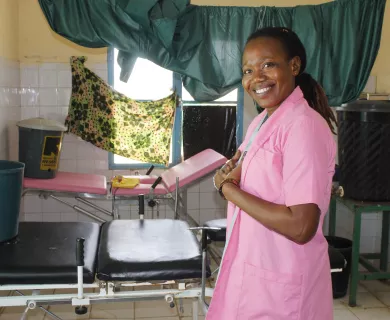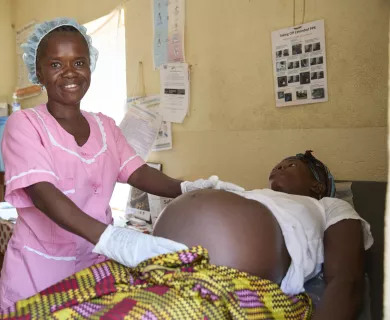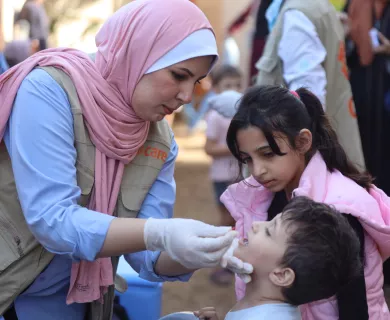


CARE and our partners help ensure the universal right to health by working with communities to create health solutions together, remove barriers, and demand access to services.
Around the world, hundreds of millions of people still cannot access basic health services. In 2021, nearly half of the global population, about 4.5 billion people, were not fully covered by essential health care.
Clinics may be too far away, lack basic supplies, or be understaffed. Many communities simply do not have enough trained health workers to meet people’s needs.
Women and girls are affected most as harmful biases and social practices often limit their access to care. Every day, about 700 women die from preventable causes related to pregnancy and childbirth. Most of these deaths occur in low-income countries and could be avoided with timely, quality care.
In humanitarian crises, these risks increase even further as violence rises, reproductive health services disappear, and already fragile health systems struggle or stop functioning altogether.
Health care should not depend on where someone lives, their income, or whether they’re a man, woman, boy, or a girl. Access to health care is a basic human right and is essential for people to live safe, productive, and fulfilling lives.
CARE and our partners strive to support everyone — especially women and girls and those with the least resources — to achieve better health outcomes.
By 2030, we aim to support:
50 million people exercise their right to health and access quality health service
30 million women and girls to realize their right to reproductive health, including access to contraception, safe childbirth, prevention and treatment against sexually transmitted diseases
Achieving these goals requires strong health systems rooted in the communities they serve. Well-trained and fairly paid frontline community health workers are essential to expanding access, improving quality of care, and reaching people at the last mile.
How CARE supports Health
CARE works with communities, health workers, local organizations, and governments to expand access to health care and ensure services are high quality, safe, and equally accessible for everyone. This means addressing health challenges from multiple angles, depending on what people need most in a given context.
First, we tailor our work to local realities. Health risks look different from one place to another, and our response reflects that. If there is a cholera outbreak, for example, CARE supports clinics to provide treatment while also helping communities access clean water and sanitation to stop the spread of disease. When infection rates are high, we work alongside communities to identify practical solutions that reduce risk and prevent illness before it starts.
We aim to tackle the greatest health gaps, focusing on the most urgent health gaps, wherever they exist.
Second, we recognize that health is connected to everything else people experience. Health needs are addressed across all of CARE’s programs, whether related to nutrition, climate change, or livelihoods. Rising temperatures, for instance, can increase risks during pregnancy. In Iraq, CARE worked with communities to reduce cases of premature birth, eclampsia, and stillbirth among pregnant women exposed to extreme heat.
By treating health as a cross-cutting priority, we help protect people’s well-being in a wide range of settings.
Finally, our approach goes beyond providing services alone. We also work to address the deeper social and structural barriers that prevent people from accessing care, including gender inequality, limited resources, and weak health systems.
This can mean supporting governments to strengthen health policies or working with communities to challenge harmful practices. For example, CARE’s IMAGINE project in Niger and Bangladesh works with married adolescents, families, and communities to delay first pregnancy and support healthier outcomes for young women.
CARE's health work in practice: She Heals the World
Frontline community health workers are vital to healthy societies. They live and work within their communities, providing primary health care — from basic first aid and home visits to specialist referrals. When clinics are far away or lack resources, their work is often the only, and sometimes lifesaving, option.
Despite their essential role, these workers are frequently underpaid and under-supported. Women make up 70% of the global frontline community health workforce and are disproportionately affected by these challenges.
CARE’s She Heals the World initiative is working to change this by ensuring frontline community health workers receive the recognition, support, and fair pay they deserve.