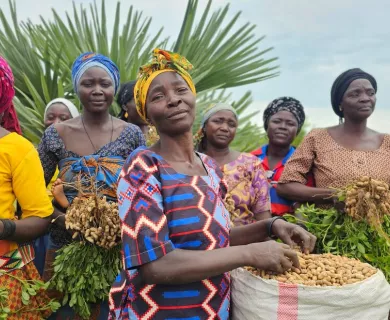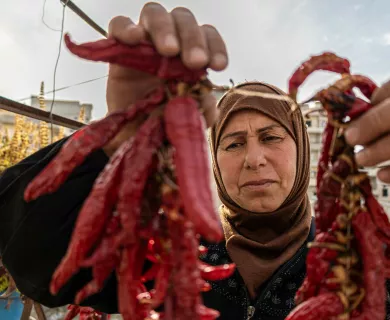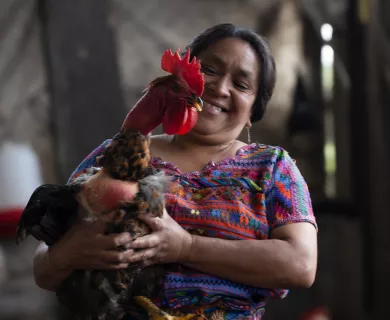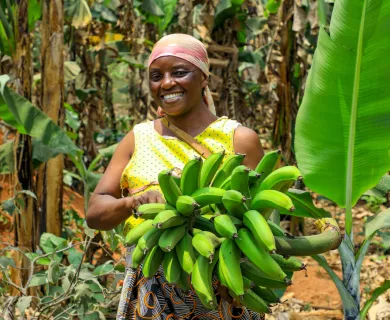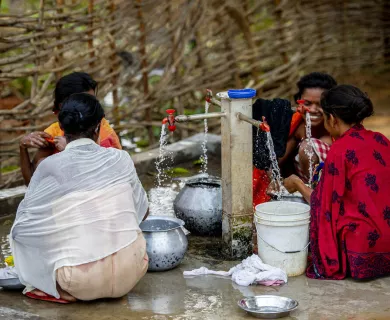


CARE and our partners help build sustainable, equal, and resilient food and water systems that ensure access to safe food, clean water, and sanitation for all.
Access to food, clean water, and safe sanitation is essential for health and dignity. Yet for billions of people, these basics remain out of reach.
Today, more than 2.5 billion people do not have enough food or access to safe drinking water, while 3.4 billion lack access to safely managed sanitation. This means that one in four people globally is missing what should be fundamental to everyday life: food, nutrition, water, and hygiene.
Lacking these essentials affects every part of life. It is difficult to work, study, or rest when you are hungry or thirsty. It becomes even harder when illness results from unsafe water or inadequate sanitation. These challenges trap people in a vicious cycle of poverty and food insecurity.
The good news is that solutions exist. But they must target the entire system.
Emergency food or water distribution helps in the short-term, but lasting change requires integrated, evidence-based approaches. CARE calls this the SuPer approach, which focuses on solutions that are:
- Sustainable, protecting the environment and ensuring long-term access to food and water.
- Productive, helping small-scale farmers grow more food and earn stable incomes.
- Equal, addressing inequalities faced by marginalized groups, especially women and girls.
- Resilient, strengthening people’s ability to withstand financial shocks, climate impacts, and other risks without falling back into poverty.
Local partner organizations and communities are central to this approach. Together, we identify root causes, develop solutions, and ensure progress continues beyond any single program.
Focus on women and girls
Women and girls face the harshest impacts of hunger and water scarcity. When food is limited, they often eat last and least. In 2025, 63.5 million more women than men experienced hunger, compared to 44.8 million in 2023.*
When water sources dry up, women and girls are usually responsible for finding it. This can force them to drop out of school or paid work and exposes them to serious safety risks. Women and girls collect water in seven out of ten households without water on-site.
Yet women and girls also hold immense potential to drive change. With equal access to resources, education, and opportunities, they can increase food production, strengthen livelihoods, and better support their families, often in more sustainable ways.
CARE, our partners, and the women we work alongside help unlock this potential.
*CARE calculates this figure using the underlying data from FAO.
How CARE improves access to food and water
Food, water, nutrition, health, education, climate resilience, and economic opportunity are deeply interconnected. Addressing them in isolation can help, but it will not end hunger.
Lasting change requires tackling the root causes of hunger at the same time. CARE works across six interconnected pathways to multiply impact and strengthen food and water systems.